
Innovation sounds exciting. Big ideas. Big words. Big promises. Yet inside many public offices and private companies, nothing really changes. Files move slowly. Decisions take forever. Trust is weak. People work hard, but systems work against them. This is where real innovation begins, not in theory, but inside the daily systems that shape results.
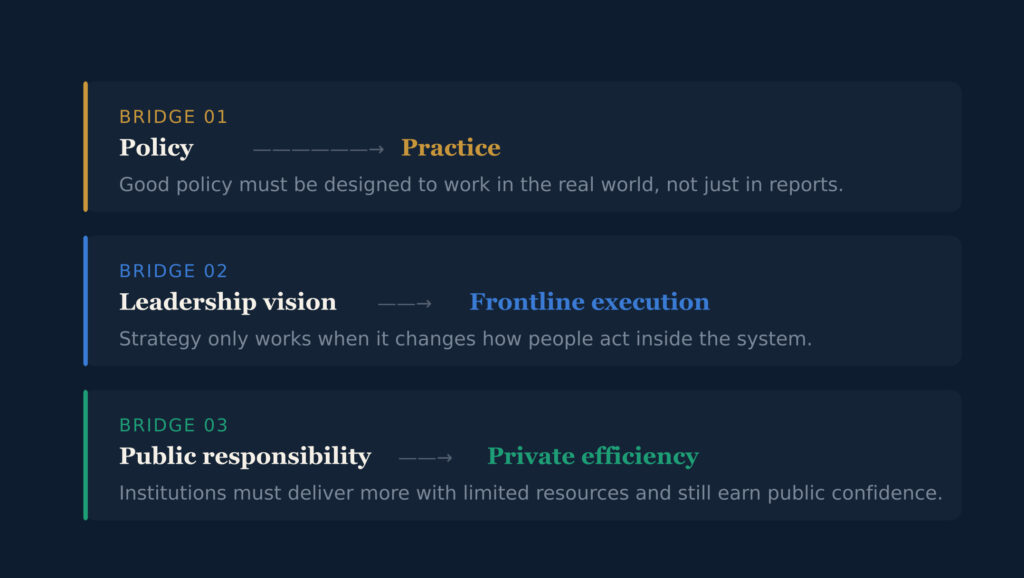
Across the world, serious institutions now agree on one truth. Innovation is not about creativity alone. It is about structure, behavior, and execution. At Harvard University, this thinking is strongly shaped by Michael Porter, whose work shows that organizations fail not because they lack ideas, but because their systems reward comfort over results. Strategy only works when it changes how people act inside the system.
At University of Oxford, public sector innovation is deeply influenced by Mark Moore, who explains that policy succeeds only when public value, operational capacity, and legitimacy move together. In simple terms, good policy must be designed to work in the real world, not just in reports.
At Massachusetts Institute of Technology, innovation thinking is shaped by Eric von Hippel, whose research proves that innovation spreads when systems allow users and workers to improve processes themselves. Innovation survives when people closest to the work can act without fear.
Public institutions carry a special responsibility. They manage trust. They manage risk. They serve everyone. When systems are slow, trust breaks. When trust breaks, compliance drops. Research from London School of Economics, led by thinkers like Mariana Mazzucato, shows that citizens judge institutions by service experience, not policy language. Speed, fairness, and listening matter more than slogans.
Private organizations face a different pressure. Competition moves fast. Customers compare instantly. Talent leaves quickly. At Stanford University, innovators like Steve Blank show that winning organizations shorten decision cycles, remove excess approvals, and build feedback into daily work. Innovation here is not a department. It is a discipline.
This is where NiBS University Ghana stands apart. NiBS does not teach innovation as theory. It teaches how innovation actually works inside real institutions. Learners study how systems slow people down and how to redesign them for speed without losing control. They learn how trust is built through process, not speeches. They see how policy, business, and execution must move together, or nothing moves at all.
NiBS positions innovation as a bridge. A bridge between policy and practice. A bridge between leadership vision and frontline execution. A bridge between public responsibility and private efficiency. This thinking reflects global research, yet it is grounded in African realities, where institutions must deliver more with limited resources and still earn public confidence.
The psychology is simple and powerful. People do not resist change because they hate progress. They resist because systems make change feel unsafe. When innovation respects this truth, adoption rises. Performance improves. Results appear. This is the same systems thinking used by global institutions such as the World Bank, where small process changes create large impact.
The future belongs to institutions that understand one thing clearly. Innovation is not noise. It is disciplined design. It is clear systems. It is leadership that builds environments where people can succeed. Organizations that master this will move faster, serve better, and earn lasting trust.
For leaders, professionals, and researchers ready to shape that future, the journey starts with the right education. NiBS invites you to explore advanced learning opportunities where rigorous thinking meets real execution. This is where doctoral education begins in Africa, and where innovation is not just studied, but lived.
This article was developed through the School of Executive Education and Development (SEED) at NiBS University.
Explore SEED.
Philip G. Joachims
Senior Manager @NiBS University