
From Accra to Vienna: What It Takes to Get Published and Presented at AOM 2027
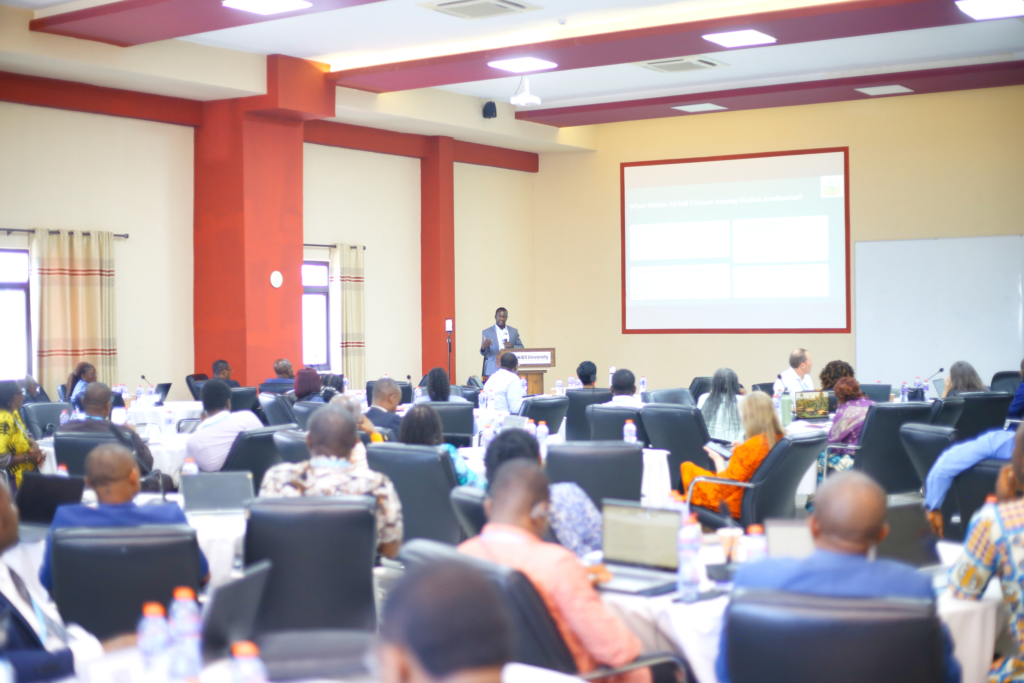
The Academy of Management (AOM) will hold its 2027 Annual Meeting in Vienna from late July to early August, and doctoral candidates and early-career researchers at the NiBS University workshop under the AOM Community Accelerator Program were urged to work towards it. The ticket to Vienna is a submission, and the deadline is 5 January, with no extension.
The facilitators did not just point at the finish line. They handed over the map: how to submit, how to open a paper, why papers fall at the first hurdle, and how to join the people who judge them.
Beat the crowd
Everyone leaves it to the last minute, and that is the trap. In the final 24 to 48 hours, the submission website becomes congested. Professor Michelle, of the University of Amsterdam Business School, advises: set your own deadline, and make it 2 January.
After that, the waiting game. Reviewing runs from January into February, and decisions arrive in March.
Five rules of the road
- One paper, one home. A paper, poster, or symposium goes to one division. Symposia are the exception, and can name up to three potential sponsors.
- Three is the limit. No one may appear in the programme for more than three papers or symposia, or more than three PDWs (professional development workshops) as an organizer or expert panelist.
- Forty pages, no names. A paper must be complete, never an extended abstract: 40 pages at most, 12-point font, double-spaced, with a submission number on each page instead of an author’s name. Break the format and the system can reject it before a human ever reads a word.
- Think small, enter big. Posters are a new, more inclusive format of about 1,750 words, with the first 250 words summarizing the rest. Professor Michelle asked every participant to submit one.
- No reruns. Papers under review at a journal, or presented at other conferences, are welcome. Papers already published or accepted, or presented at AOM in the same version, are not.
Know the odds
For symposia, the cap on acceptance is 75%. About 90% of PDWs submitted in January get in. Divisions may accept up to 100% of posters. Full papers are the hardest road onto the programme: last year Professor Trent Williams, editor of Entrepreneurship Theory and Practice at Brigham Young University, evaluated about 950 of them and had to turn down half.
Can’t travel? There are on-demand options. And before the session ended, participants had already begun: each mapped a current or imagined project to a division, a backup division and a session type, then tested it on a group.
Hook them on page one
Readers decide what they think of a project on the first page, Professor Williams warned. His answer is a five-step arc: common ground, complication, concern, course of action, and contribution. In other words, tell it like a story.
Professor Michelle took the idea further with the well-known 2011 Academy of Management Journal article by Grant and Pollock, which builds an introduction in five paragraphs: capture attention, say what we know, say what we don’t yet know, state your work, and outline your specific paper. A quote from your own data or a short vignette can do the capturing.
Professor Williams then showed his workings. The first line of one of his own papers began with a literature-led sentence about organisational emergence and, after several drafts, ended up about compassion, localness and community. One title went through half a dozen versions before it landed. His lessons:
- Write the contribution first. The hook comes later.
- Consider opening with the phenomenon.
- Choose one home conversation.
- Use a hook you own, and check every fact in it.
- State the theoretical contribution in a single sentence.
Phenomenon or theory? Professor Michelle’s verdict: you need both. “You can’t just tell a story about a phenomenon, because that’s not academic research.” One participant described eight years spent on the kgotla, the Botswana public meeting, before finding the theoretical angle: institutions as practice.
Publishing is not a sprint. Professor Williams was candid that top journals are extremely competitive and slow, and urged participants to match their work to suitable outlets and keep several papers in the pipeline. A participant added a warning: beware predatory journals that promise rapid publication for a fee.
Five ways to get rejected
Beyond formatting errors, the facilitators named the usual suspects:
- No real contribution (“a gap is not a contribution”)
- Missing theory
- Joining the wrong conversation or division
- A buried hook
- A method or design that cannot answer the question
Professor Gilbert Kofi Adarkwah, an associate editor at HEC Montréal, put it plainly: finding something not yet studied in a given context is not enough if it adds nothing new to how we think.
Professor Michelle warned against claiming causation from weak data, against common method bias and against endogeneity in quantitative work. She said qualitative papers should show their data and not stop at themes. Mixed methods? Each method needs a clear reason, and doing both well is harder than it looks. And a theory paper, Professor Williams said, “is like trying to do an empirical study without data”, so it must go well beyond a literature review.
The autopsy
Then came the live dissection. Participants took apart a sample abstract on social media marketing among SMEs in Ghana. The verdict: a vague “firm performance” outcome, no reason for choosing Ghana, no clear research question, a single cross-sectional survey claiming causation, and the empty ending “implications are discussed.”
The session closed with five questions every researcher should ask before pressing submit:
- Can I state my contribution in one sentence?
- Which conversation am I joining?
- Is there a why behind each claim?
- Can my design answer my question?
- Have I checked every rule in this year’s call?
Cross to the other side of the desk
Professor Anastacia Mamabolo, an associate professor at the University of Pretoria, called to review for AOM Life-Changing and said doctoral students are known for being excellent reviewers. Reviewing, she said, shows you what good work looks like, helps you find your own voice, gives you feedback on your reviews, lets you give back and gets you noticed by editors. A good review summarizes the paper in the reviewer’s own words, states its strengths, sets out numbered and specific concerns, and offers developmental suggestions.
Professor Williams, on the other hand, listed what reviewers look for: a clear, well-motivated question, theory that extends a conversation, a method that fits the question, credible findings, and a convincing “so what?” Professor Michelle urged kindness and timeliness, and noted that reviewing can lead to editorial board roles. Her one hard line: never upload someone else’s manuscript into an AI tool.
The parting message to participants from the Founder of NiBS University, Professor Kwaku Atuahene-Gima, was that the workshop is “just the beginning of your scholarly career.” Vienna is the next stop.
Ready to join? Create an AOM account, go to the Reviewer Center, and choose your divisions. Expect about three papers per interest group.